Richer Noise Models, Smaller Active States (v0.12.0, October 2026)
Clifft 0.12.0 extends leakage and loss modeling with configurable effects on gate partners and status checks that circuits can act on. Two new default compiler passes find smaller active states, and optional batch tuning helps choose an efficient execution configuration for longer sampling jobs.
Extend leakage and loss models
When a gate encounters a leaked or lost qubit, simply skipping that gate may miss a disturbance to its partner. Clifft's new PartnerEffect lets a noise model apply Pauli errors to the computational partner, or spread leakage from an already-leaked source. The source keeps its status. These effects can capture correlations that influence later gates and measurements.
Protocols also need to detect leakage or loss during a circuit. The new HERALD_LEAKAGE_EVENT and HERALD_LOSS_EVENT probes append ordinary measurement-record bits without changing the site's state or occupation. Detectors, observables, and feedback can use those bits at the point of the check.
This example combines both capabilities. Leakage on qubit 0 spreads to qubit 1 at a two-qubit gate, and a detector reports the partner's leakage. A separate lost qubit illustrates the distinction between leakage and loss:
from clifft import noncomp

model = noncomp.Model(
    gate_partner_effects={
        "leaked": noncomp.PartnerEffect(spread_probability=1),
    }
)
result = noncomp.sample(
    """
    LEAKAGE(1) 0
    CX 0 1
    HERALD_LEAKAGE_EVENT 1
    DETECTOR rec[-1]
    LOSS(1) 2
    HERALD_LEAKAGE_EVENT 2
    HERALD_LOSS_EVENT 2
    """,
    model,
    shots=16,
    seed=1,
)
assert (result.measurements == [1, 0, 1]).all()
assert result.detectors.all()
The first record bit flags leakage on qubit 1. The next two show that qubit 2 is lost rather than leaked. Unit probabilities make the example deterministic; a physical noise model supplies the appropriate rates. The probes themselves are perfect and take no arguments; READOUT_NOISE can model missed detections and false positives.
Partner effects are opt-in. A model can set defaults, use InteractionRule to select particular gates and operand directions, or place explicit effects in the circuit. Both leaked and lost sources can disturb a partner with Pauli noise; only leaked sources can spread leakage. See Partner Interactions and Nondestructive Status Checks for the configuration options.
Find smaller active states
Clifft's sampling cost depends on the quantum state that remains after the compiler has accounted for Clifford structure. A circuit can contain many non-Clifford gates while preparing a state that needs only a small dense array. Finding that smaller representation saves work on every shot.
The compiler already combines nearby rotations and uses squeezing to shorten active lifetimes. The two new passes also exploit what is known about the state: Clifft starts with every qubit in |0> and follows the circuit to find rotations that act identically on the state being simulated. If noise or measurements invalidate a fact about that state, the passes stop using it.
Reduce commuting T rotations
PhasePolynomialPass finds relationships across a group of commuting T rotations and expresses their combined action using fewer independent phase variables. It uses Vandaele's TOHPE algorithm to reduce the T count and preserves the Clifford correction needed for the same quantum evolution.
Encoded transversal-T circuits are a useful application. Preparing an encoded state establishes relationships among physical qubits that the pass can use to reduce the active state. Examples come from triorthogonal codes for magic-state distillation by Bravyi and Haah and Haah and Hastings.
On 1,037 noiseless triorthogonal circuits, the new defaults lowered median peak active width from 17 to 1. Using the published 0.12.0rc1 wheel, a local single-thread scalar comparison against fusion and squeezing alone measured a median per-circuit sampling speedup of about 9,600x, with median compilation time rising from 0.54 ms to 6.95 ms.
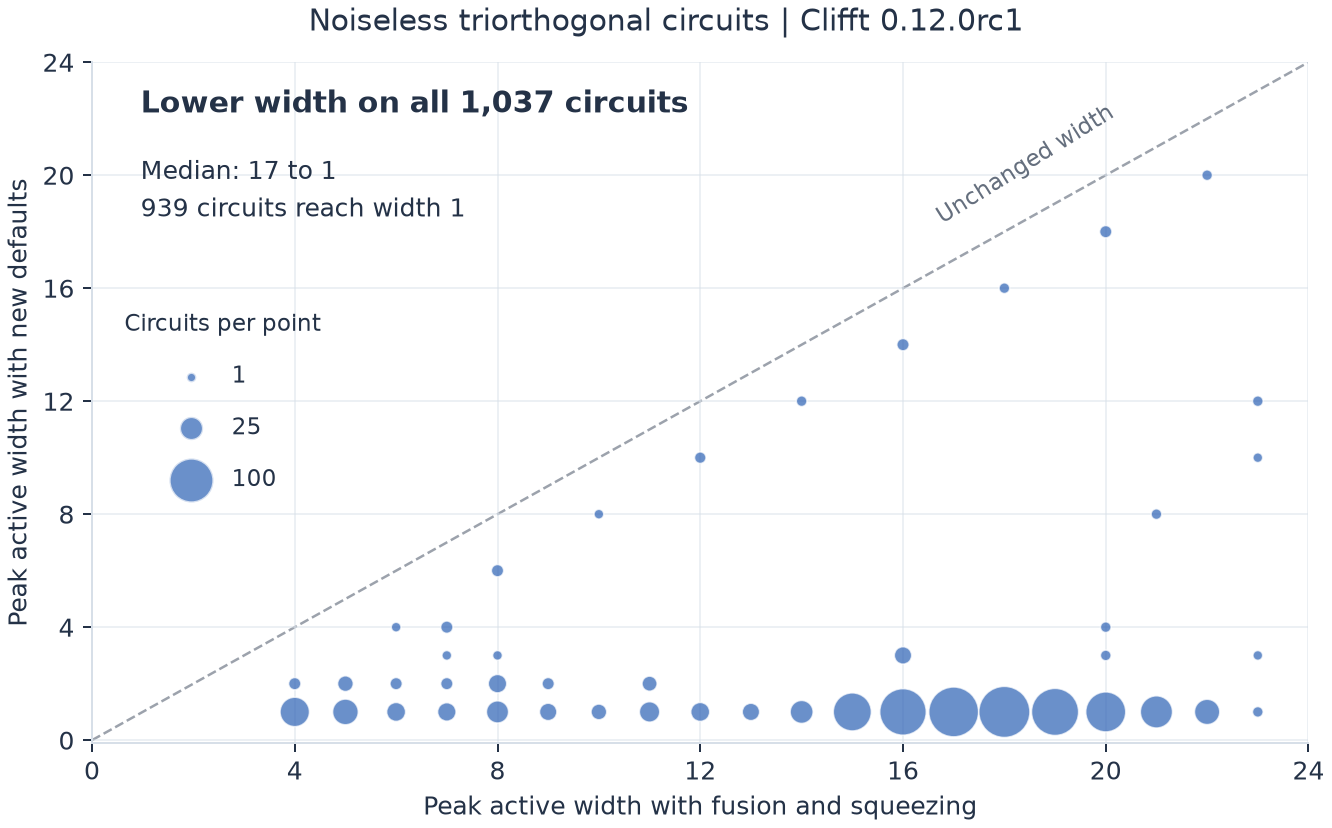
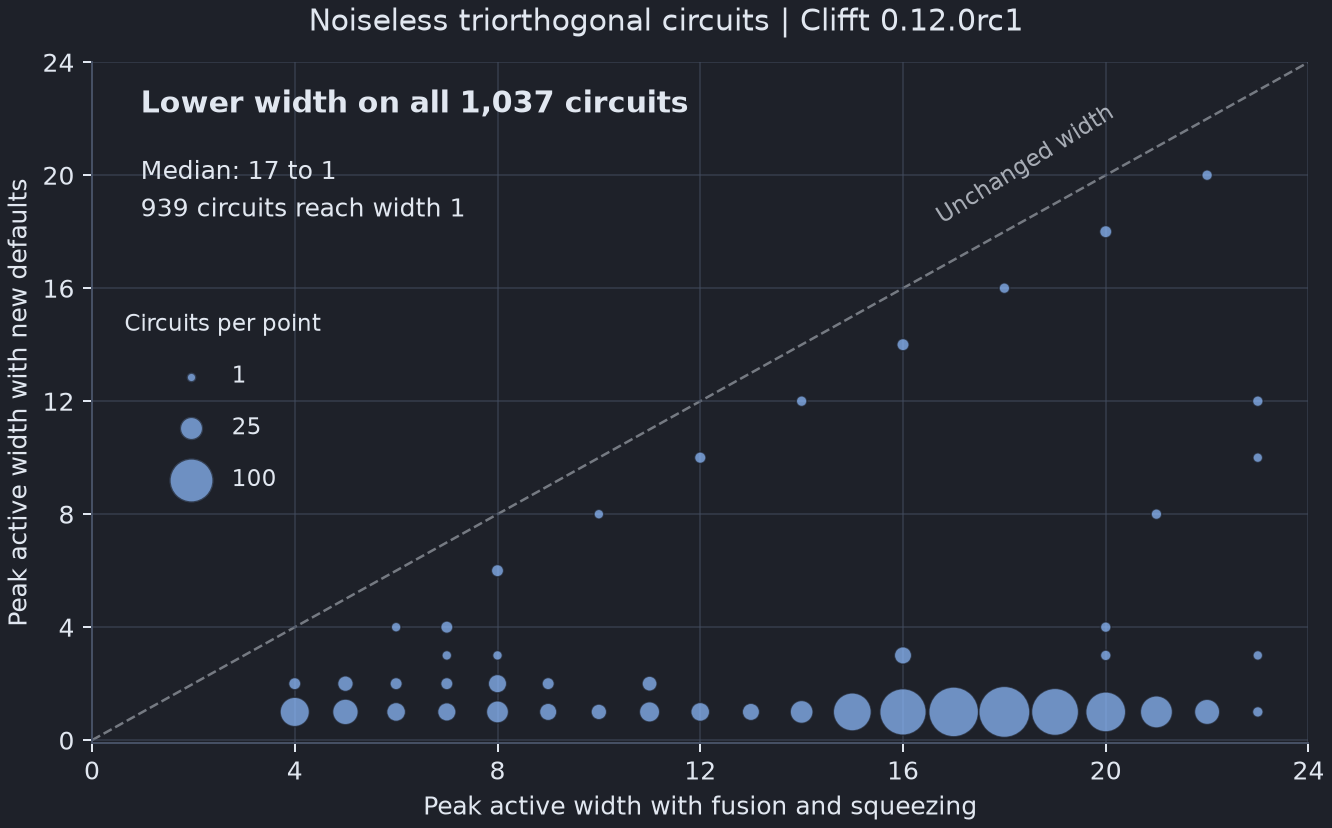
Thanks to Matthew Cha of Riverlane for putting these circuits together.
Simplify arbitrary-angle rotations
RotationSimplificationPass extends simplification to arbitrary angles. It combines rotations around different Pauli products when they act identically on the prepared state, then absorbs any resulting Clifford operations. For example, qubit 1 remains in |0> here, so Z0*Z1 acts like Z0 and the two rotations cancel:
import clifft

source = """
    H 0
    R_Z(0.137) 0
    R_PAULI(-0.137) Z0*Z1
"""
program = clifft.compile(source)
assert program.peak_active_width == 0
Changing the preparation of qubit 1 can invalidate that equivalence. A larger example is the fixed-input 16-bit Draper QFT adder from MQT Bench, retained as a 32-qubit fixture. It adds a=37449 to b=18724, preserving a and returning b=56173.
| HIR pipeline | Peak active width | Peak dense-state dimension |
|---|---|---|
| Peephole fusion and squeezing | 15 | 32,768 |
| Add phase-polynomial reduction | 14 | 16,384 |
| Add rotation simplification, the new default | 0 | 1 |
The new defaults eliminate the dense-state growth for these prepared basis inputs. The table compares pass selections on the same published RC, with optional active-width scheduling disabled.
The official clifft-bench results show a roughly 33,050x sampling speedup for this noiseless fixed input, with compilation falling from 3.41 to 2.06 ms. This compares 0.12.0rc1 with 0.11.0rc1 on one pinned CPU, with scheduling enabled and independently calibrated batch sizes of 1024 and 1, respectively. Sampling rates exclude compilation, calibration, and warmup.
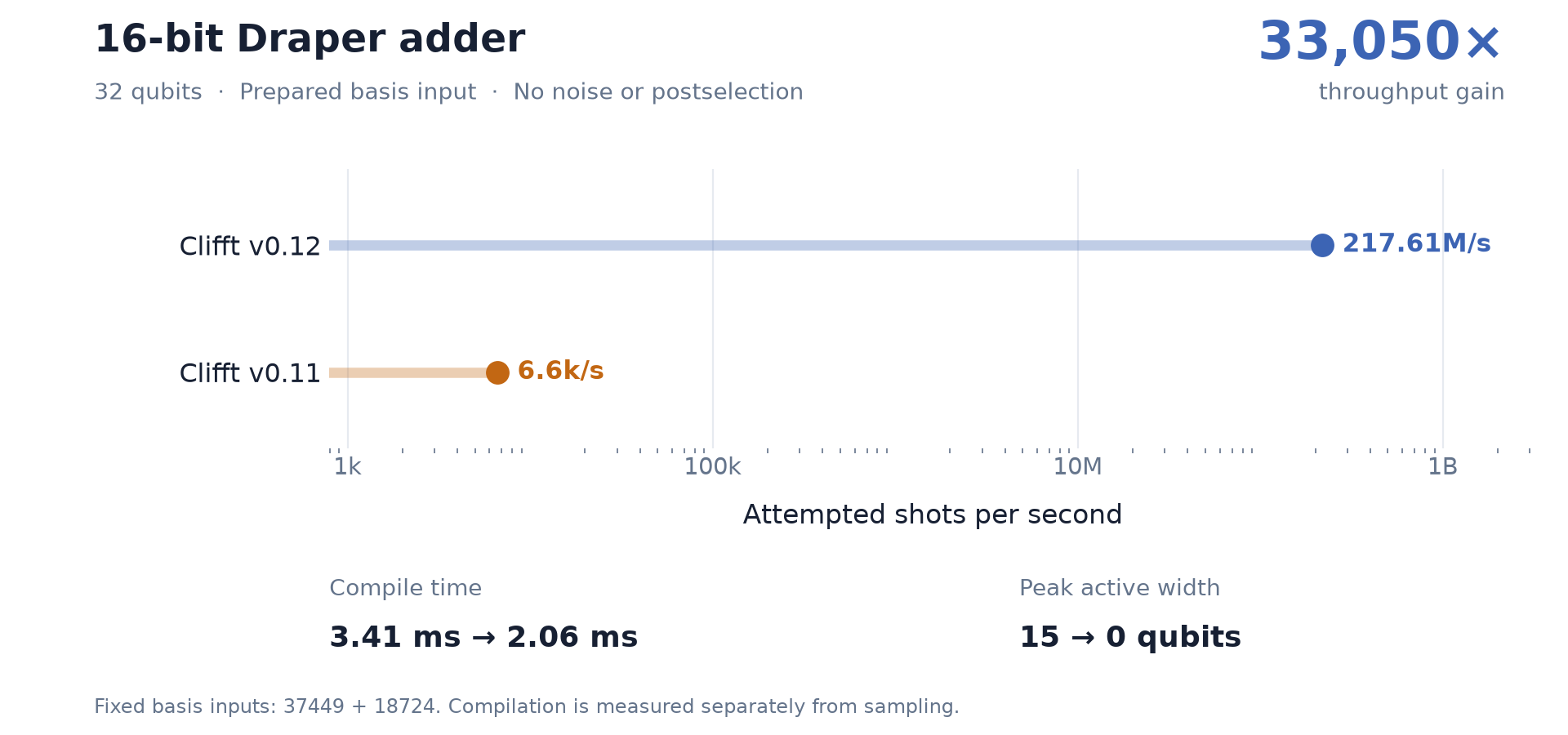
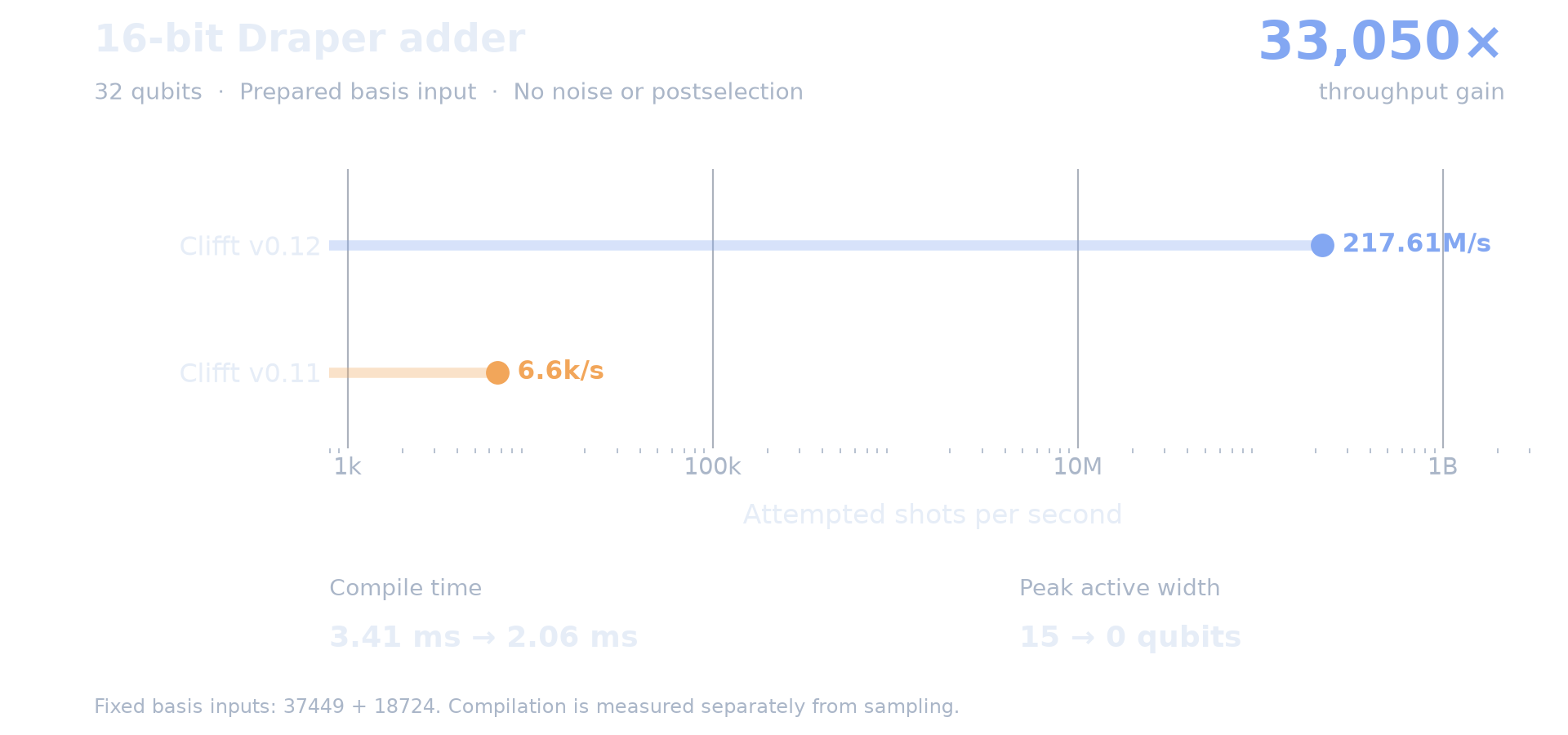
Tests check relative phases and correlated measurement records against independent Qiskit Aer and Stim references where applicable, including noisy circuits and adders with entangled inputs. Both passes are enabled by default for ordinary compilation and excluded from leakage/loss continuations. ActiveWidthSchedulePass remains opt-in. See the pass reference for controls and applicability, and the release notes for the changed defaults and fixed-seed behavior.
Tune batch sizes for longer jobs
A compiled circuit's fastest sampling configuration depends on the machine, output mode, and shot count. The default batch_size="auto" uses heuristics. The new batch_size="tune" option measures eligible batch capacities before running the requested shots:
import clifft

program = clifft.compile("H 0\nT 0\nH 0\nM 0")
result = clifft.sample(
    program,
    shots=100_000,
    batch_size="tune",
    tuning_budget_seconds=0.25,
    seed=42,
)
assert result.batch_tuning is not None
chosen_batch_size = result.batch_tuning.batch_size
Calibration shots are excluded from the result. The budget is a soft limit, and tuning adds latency, so it is most useful for longer jobs. Reuse the reported numeric batch size on later calls with the same workload and settings to avoid recalibrating. See CPU Execution and Tuning for the report fields and reproducibility details.
Release benchmarks
The official clifft-bench campaign found QEC throughput essentially unchanged from 0.11: -1.16% to +1.90% across seven workloads, using the published RCs with scheduling and independently calibrated batching. See Performance for the results and comparisons with SymFT, xtim, and Stim.