Packed Sampling in Clifft (v0.10.0, September 2026)
Version 0.8.0 rebuilt Clifft around symbolic-coordinate sampling. Version 0.9.0 restored multicore execution, letting one worker budget run many shots concurrently or divide a wide active state across OpenMP workers.
Version 0.10.0 adds another level of CPU parallelism: packed batch sampling. Clifft can now advance a group of low-active-width trajectories together, improving throughput when each individual shot is too small to keep modern CPU execution resources busy on its own.
This remains exact simulation. Packing changes how Clifft organizes the work, not the circuit distribution being sampled.
Why pack shots?
At active width \(k\), Clifft's dense active state contains \(2^k\) complex coefficients. Wide states provide enough arithmetic to divide within a shot, while large shot counts can be spread across independent workers. But many near-Clifford workloads combine a large number of shots with small active states.
In that regime, advancing shots one at a time repeatedly evaluates the same prepared action stream and operates on arrays too short to use the CPU efficiently. Packed sampling instead treats several shots as lanes of one executor. Boolean state is stored in packed columns, active-state coefficients are interleaved across lanes, and each prepared action is applied to the group. The trajectories remain mathematically independent, but the executor shares more of the work around them.
The approach was inspired by the packed cross-shot path in SymFT, whose results on low-active-width circuits helped motivate a similar mode in Clifft. Clifft adapts the idea to its prepared sampling plans and result APIs.
Automatic when useful
Packed execution has its own bookkeeping and memory costs, so it is not faster for every circuit. The default batch_size="auto" policy considers the shot count, active width, estimated lane work, output mode, and retained storage. It selects packing conservatively for workloads expected to benefit and keeps the scalar path otherwise.
The same interface is available on the four fixed-plan samplers:
sample()sample_survivors()sample_k()sample_k_survivors()
Most users can leave the automatic policy alone. Advanced callers can set batch_size=1 to require scalar execution or request an explicit packed capacity after measuring their own workload. Automatic survivor sampling stays scalar because the planner cannot predict how long post-selected lanes will remain alive.
Packed execution cannot be combined with intra-shot OpenMP, since both modes organize the active-state kernels in different ways. The CPU execution guide documents the selection policy, supported combinations, and memory tradeoffs.
Less work before faster execution
The runtime improvements are paired with compiler work that can shrink the active state before execution begins. Clifft's statevector-squeeze pass delays expansions when intervening operations permit it, giving measurements an earlier opportunity to remove active coordinates.
Version 0.10.0 extends that motion across sequences of expanding operations that previously blocked a safe non-expanding operation. On the coherent QEC workloads used during development, this reduces peak active width from 8 to 5 for the distance-3, three-round circuit and from 24 to 13 for the distance-5, five-round circuit. Since storage and kernel work scale with \(2^k\), reducing \(k\) complements both packed and threaded execution.
Apple Silicon also gains native NEON kernels for direct and fused rotations and diagonal active measurements. Clifft selects them automatically when an operation is large enough to benefit and retains scalar fallbacks for smaller work.
Measured against v0.9.0
The matched clifft-bench release campaign calibrates each version over the supported batch capacities, then runs the selected configuration on one pinned logical CPU. Version 0.10 is faster on all eight workloads, with a 3.23x median improvement over v0.9 and a range from 1.06x to 837x.
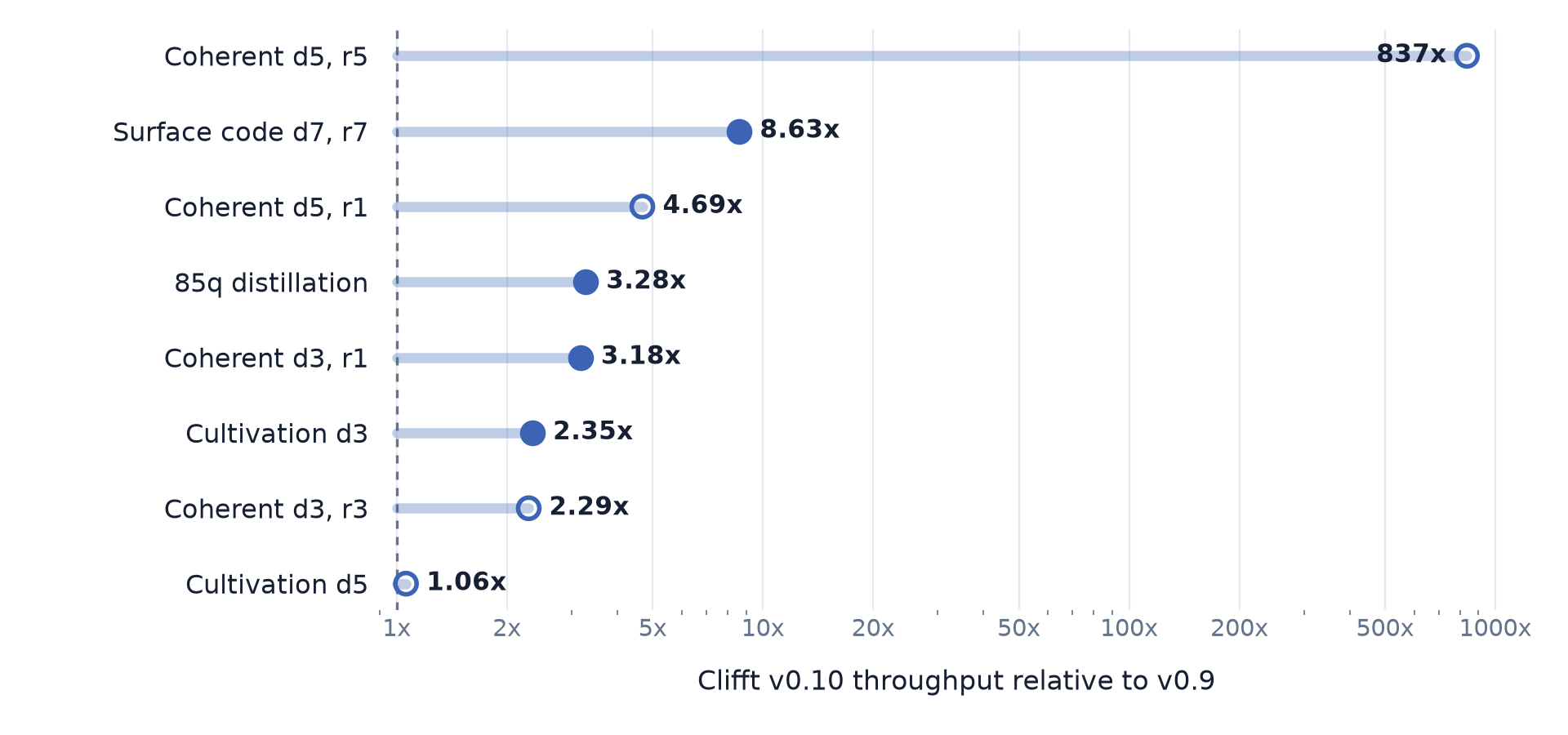
Filled markers are workloads where v0.10 selected packed execution; hollow markers remained scalar. Packing won on coherent d=3, r=1, distillation, cultivation d=3, and surface-code memory. The other four were faster on the scalar path.
The largest gain is not a batching result. Coherent d=5, r=5 remains scalar and improves by 837x after the compiler reduces its peak active width from 24 to 13. Conversely, the 1.06x cultivation d=5 result shows the per-workload calibration selecting scalar execution when packing's overhead does not pay off. The Performance guide gives the absolute rates, SymFT comparison, release history, and full measurement contract.
A more self-contained core
Version 0.10.0 also reduces Clifft's production dependency surface. Compilation, optimization, planning, exact state queries, Python, and WebAssembly now use Clifft's native Pauli strings and tableaus. Stim remains an independent test oracle, but production targets no longer fetch or link it. This reduces production build time and build-tree size without claiming a runtime speedup from the dependency change itself.
Clifft also accepts a documented unitary subset of OpenQASM 2 without requiring Qiskit. The native parser supports standard qelib1.inc unitary operations, register broadcasting, barriers, and finite constant-angle expressions. It rejects unsupported dynamic constructs rather than assigning them approximate semantics. See Circuit Inputs for the supported paths and their limits.
Together, these changes keep more work in the prepared plan, choose an execution strategy suited to the workload, and make the core package more self-contained.