Performance
Clifft is built for fast, exact simulation of near-Clifford circuits. Its compiler resolves Clifford coordinates and symbolic dependencies before sampling, then executes only the remaining branch values and dense active-state operations for each shot.
The measurements below cover three complementary questions: how Clifft compares with another near-Clifford CPU simulator, how its throughput has changed across releases, and how it behaves when a circuit becomes fully dense.
Near-Clifford throughput
The recurring clifft-bench campaign measures attempted shots per second for complete circuits on one pinned logical CPU. For each workload and simulator, it selects the best batch size for that workload before collecting the comparison.
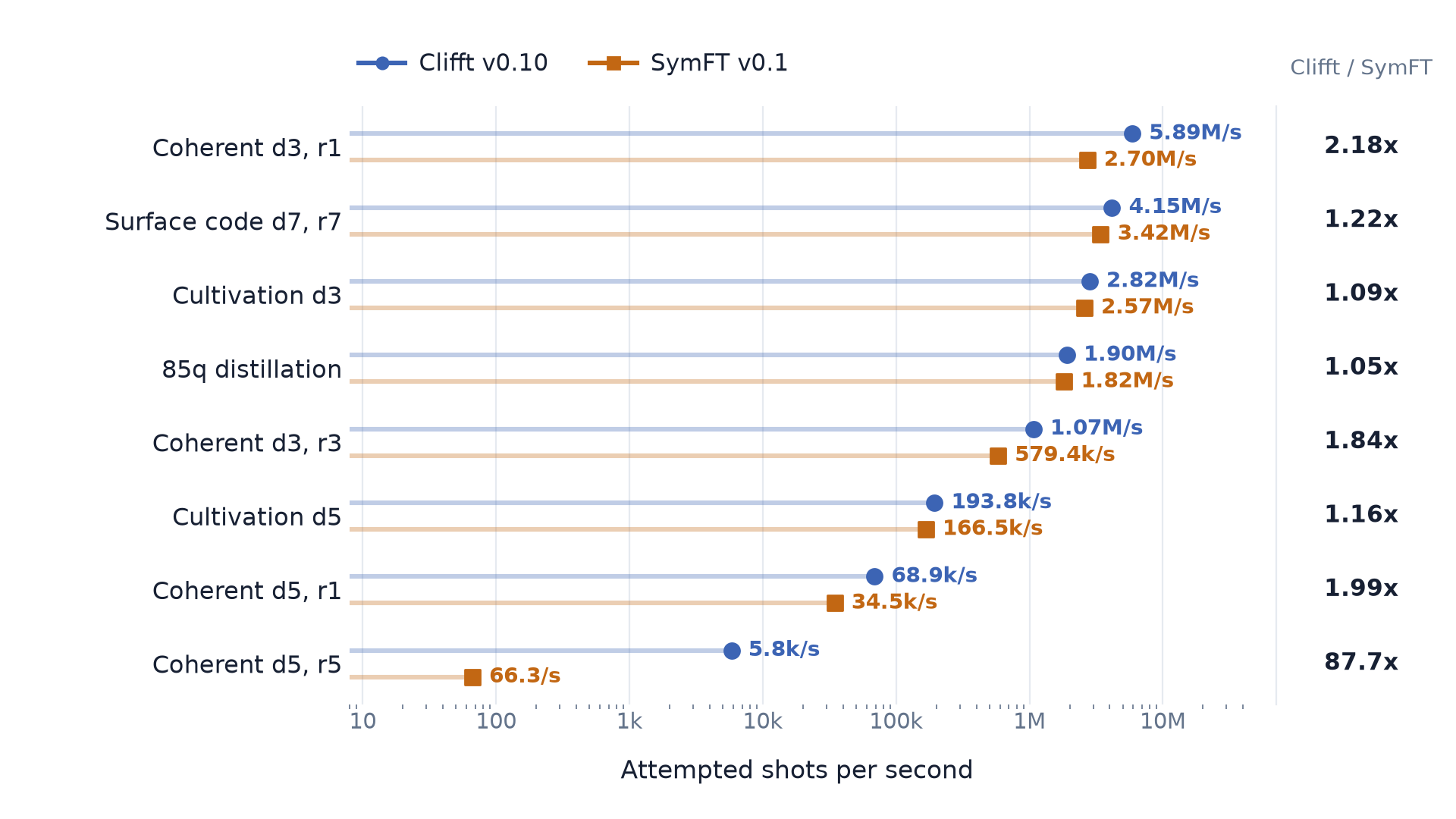
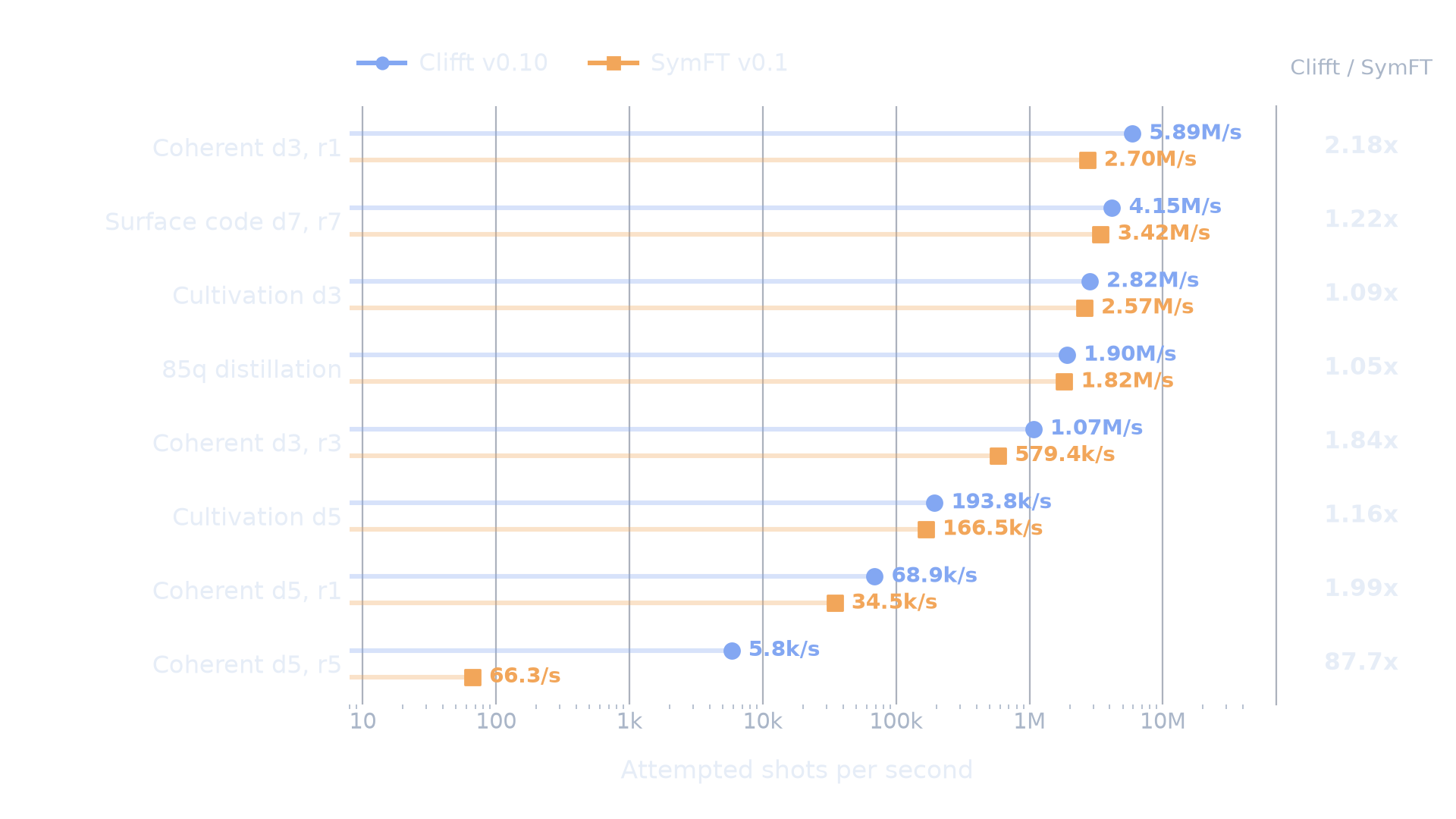
Clifft is faster than SymFT on all eight workloads. The advantage ranges from 1.05x to 87.7x, with a 1.53x median across the workload set. The plot shows both tools' absolute rates on a shared logarithmic axis; the right-hand column gives Clifft's speedup over SymFT for each workload.
These are attempted-shot rates, so post-selected shots that are later discarded still count as simulation work. The run used one placement of an AWS m7a.xlarge with an AMD EPYC 9R14, Ubuntu 24.04, and one pinned logical CPU. Each reported configuration has five timed samples of at least 30 seconds.
See the immutable comparison table and the benchmark contract for the exact software identities, timing boundaries, and result semantics.
Performance over time
Clifft's compiler-like structure provides several independent places to make simulation faster: circuit optimization, symbolic planning, executable preparation, and active-state kernels. That structure does not mean every speedup comes from the compiler, but it lets later releases improve one stage without moving circuit analysis back into the per-shot execution loop.
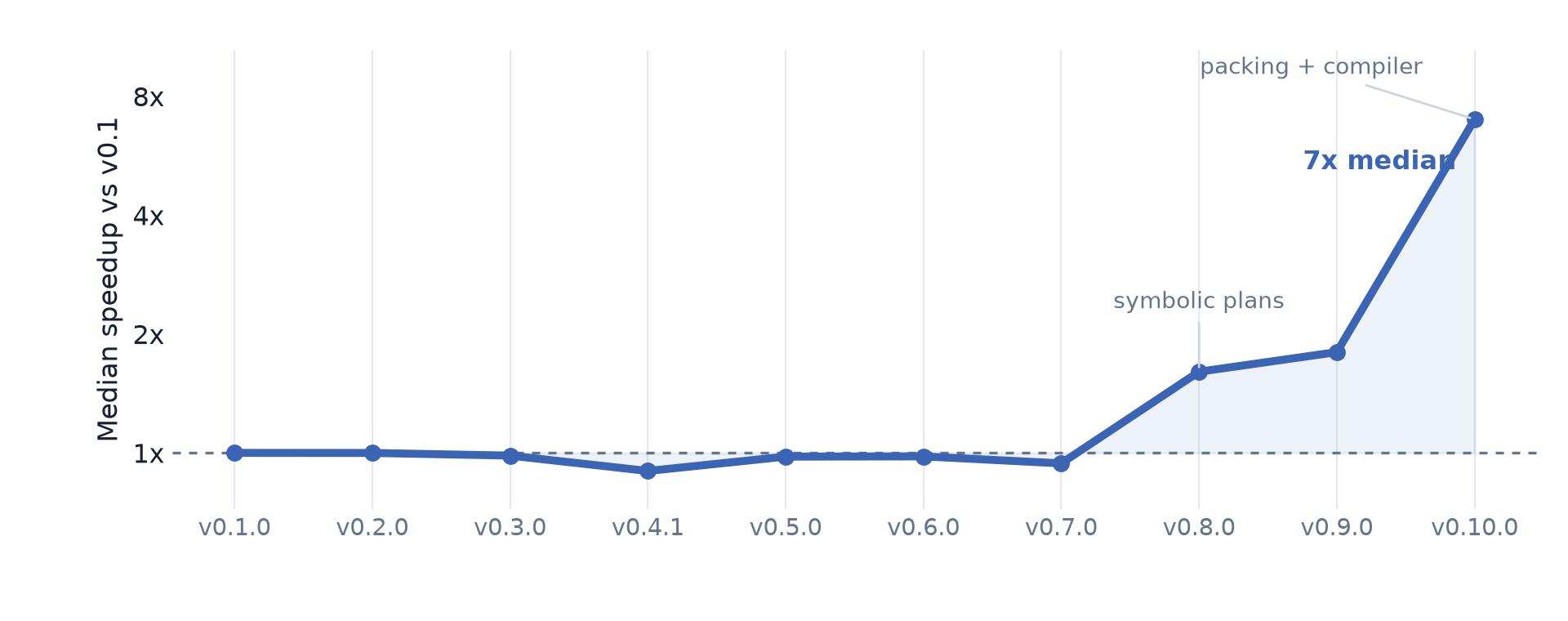
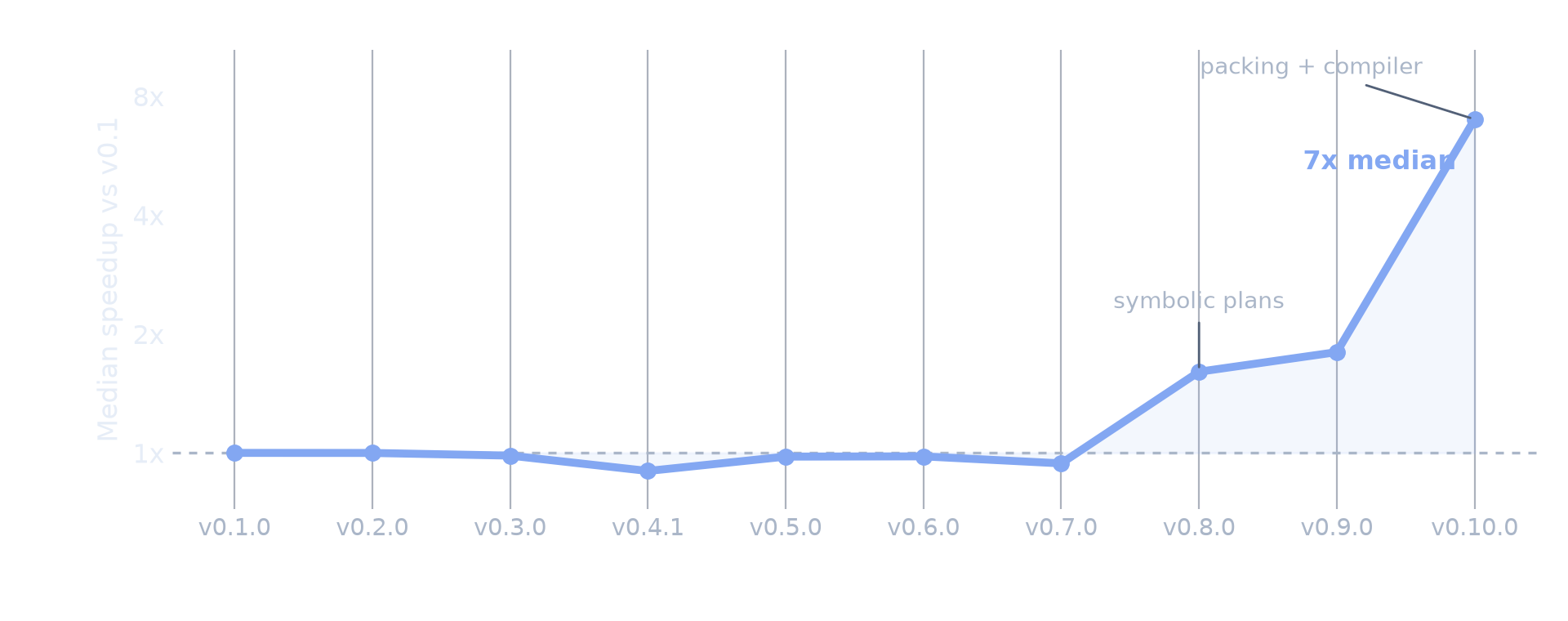
The first broad step arrived in v0.8, when symbolic plans replaced the original localized-Pauli virtual machine. Version 0.10 combines another compiler improvement with packed sampling: its median throughput is 3.23x v0.9 and 7.0x v0.1 across the eight workloads.
The largest v0.10 gain, 837x on coherent d=5, r=5, primarily reflects a compiler rewrite that reduced the circuit's peak active width from 24 to 13. This is why the release history is best read as the result of the whole compile-and-execute system, not as a benchmark of one kernel.
The v0.1 through v0.9 points come from a common history execution. The v0.10 point chains the paired v0.10/v0.9 ratio from the release run onto that history. This avoids treating an absolute difference between two host boots as a product change.
Dense Quantum Volume circuits
Near-Clifford structure is Clifft's main advantage. A dense Quantum Volume circuit instead drives the active width to the full qubit count, making Clifft carry a conventional \(2^n\) state vector. This deliberately tests Clifft where its specialized representation offers the least help.
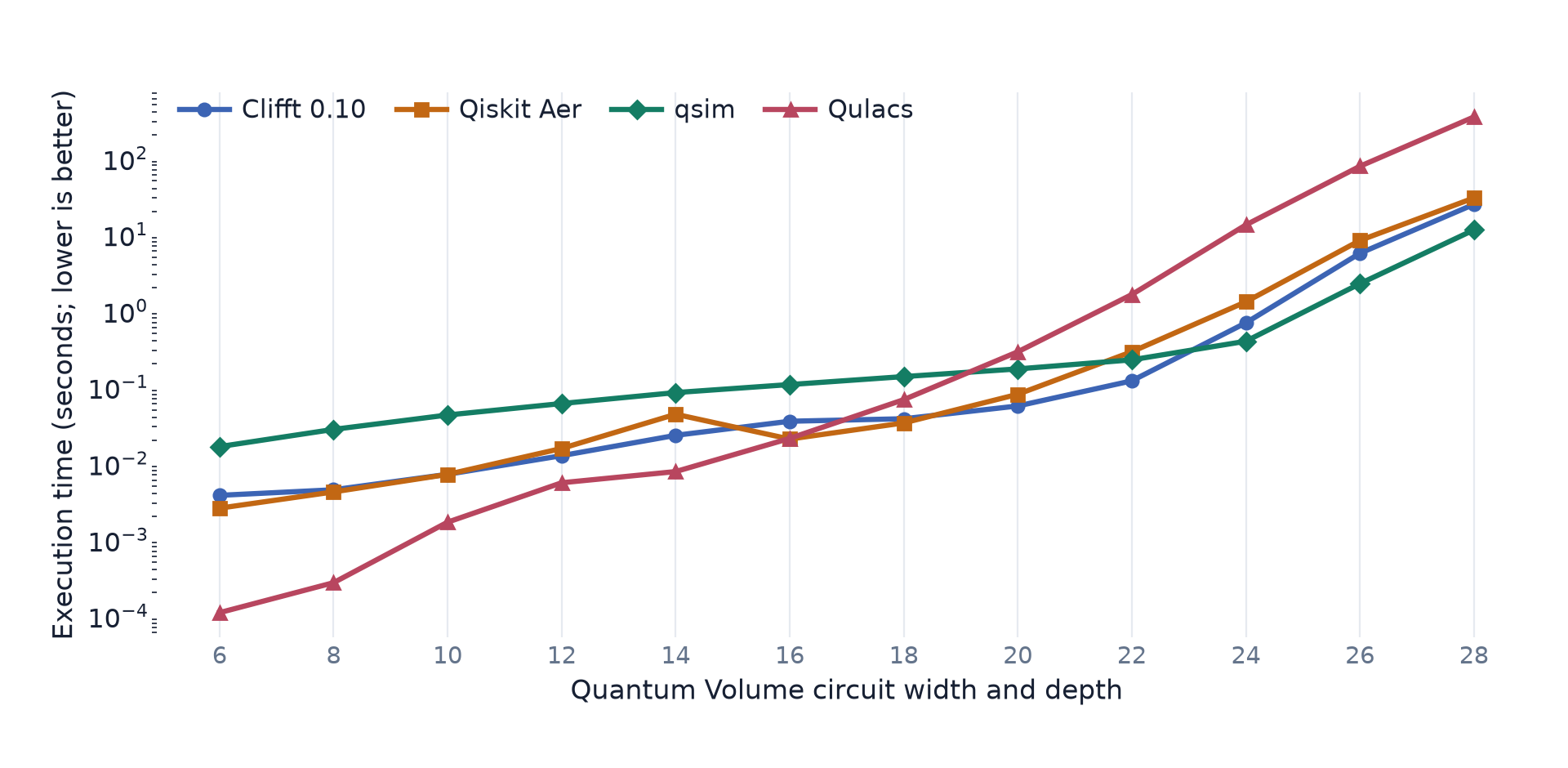
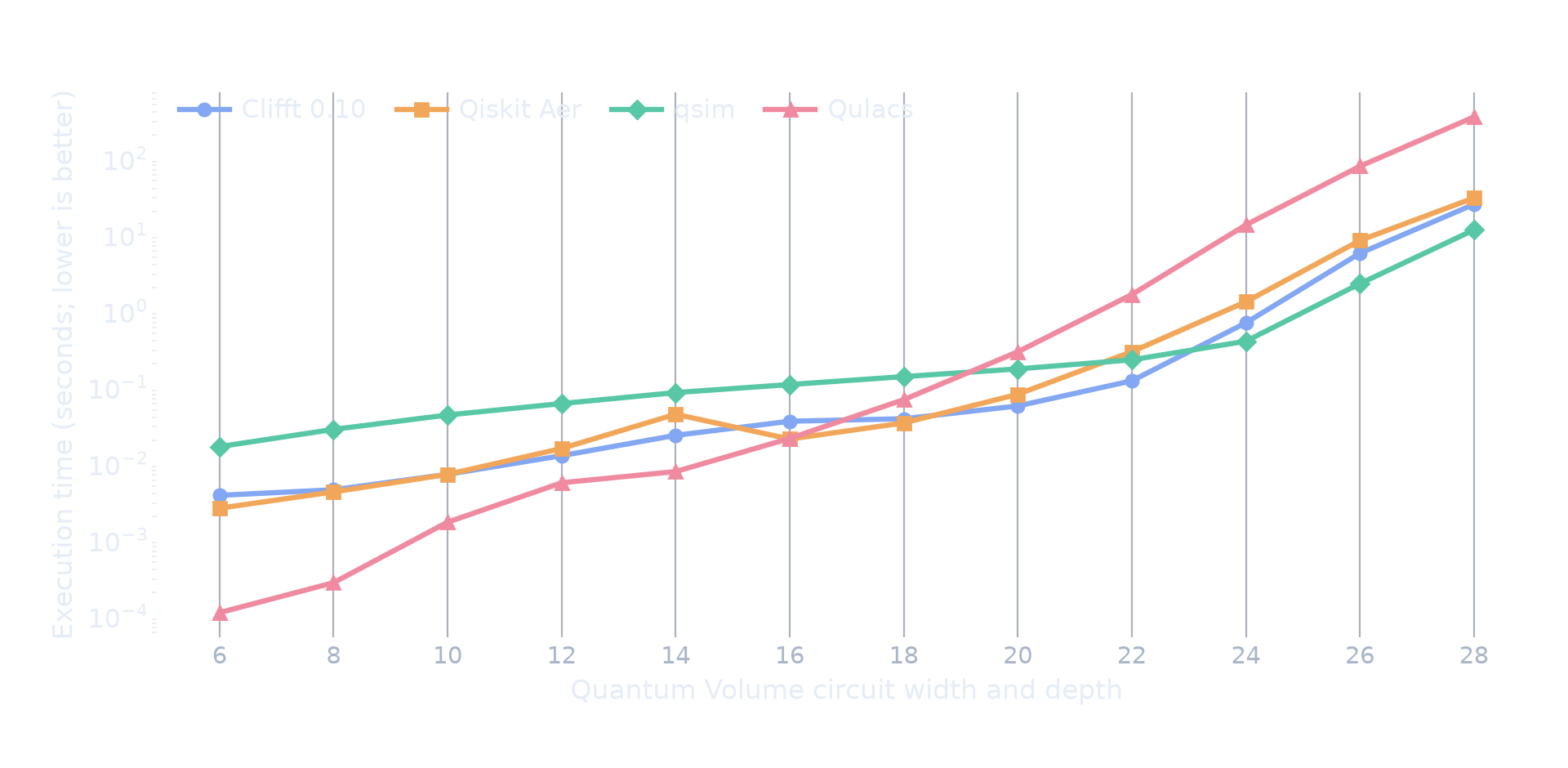
Using 16 physical CPU cores, Clifft records the shortest median execution time at QV20 and QV22. At QV28 it completes in 24.7 seconds, compared with 29.9 seconds for Qiskit Aer and 344.9 seconds for Qulacs; qsim leads at 11.4 seconds. Smaller widths favor tools with lower fixed overhead, and qsim leads from QV24 onward. The result is not that Clifft wins every dense workload, but that it remains in the leading group even outside its intended near-Clifford regime.
This experiment reproduces the original Clifft paper's timing boundaries. Clifft is charged for compilation plus one sample, while Qiskit transpilation and Qulacs/qsim circuit preparation occur before their timers. It is therefore not an equal end-to-end latency comparison. The experiment uses three circuit seeds per width on an AWS c8i.8xlarge; see the experiment description and complete result table.
Future benchmark scope
The near-Clifford comparison is CPU-only. A future campaign will cover GPU execution, including Tsim, under a separate hardware and measurement contract. A pure-Clifford comparison with Stim will likewise be added after the relevant Clifft execution changes and benchmark cases land.