Optimization for Simulation
Clifft compiles a circuit once so that repeated sampling does less work. Its default optimization passes rewrite the simulator's internal representation while preserving joint measurement-record distributions. Extra compilation effort can therefore pay off over many shots.
Cost Model
Clifft stores non-Clifford interference in a dense array of \(2^k\) amplitudes, where active width \(k\) counts active stabilizer coordinates, not physical qubits. Clifford structure stays outside this array; measurements can shrink it. See the state factorization for the underlying representation.
Peak width sets the exponential coefficient-storage cost, \(O(2^{k_{\max}})\). Sampling work also depends on how many operations process a large active array. A useful structural estimate is
where \(\mathcal{A}_{\mathrm{dense}}\) contains operations that process the dense state, and \(k(a)\) is the width of the array they process. This is a cost proxy; actual runtime also depends on kernels, memory traffic, and classical work.
Clifft reduces this cost by finding equivalent circuits that require less simulation work. For example, consider this three-qubit circuit, starting from \(|000\rangle\). In Clifft's Stim-like syntax, rotation angles are in half-turns:
Open this circuit in the explorer. To reproduce the stages below, use Passes to disable all passes, enable only PeepholeFusionPass, then also enable StatevectorSqueezePass.
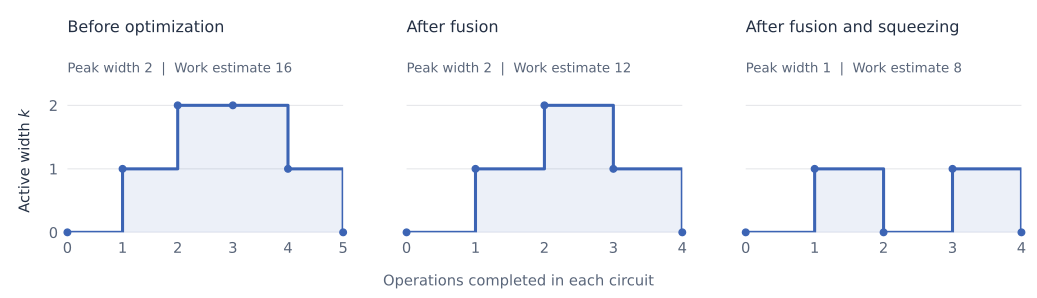
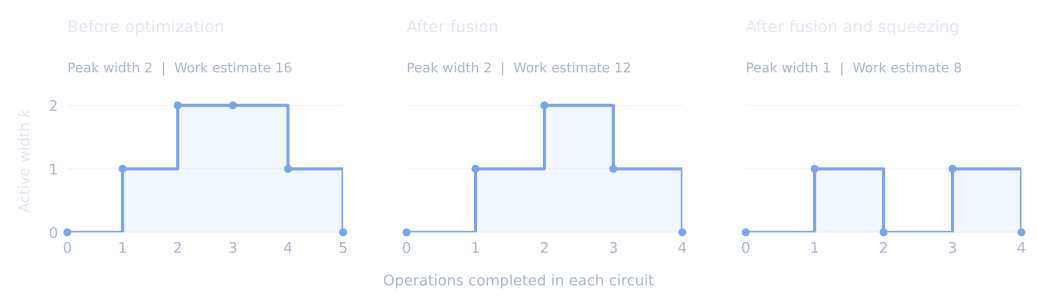
All three rotations use only \(X\) axes, so they commute. The first and third therefore fuse into one R_XX(0.25) 0 1, removing work without changing peak width. The \(Z_1Z_2\) measurement also commutes with the \(X_1X_2\) rotation: the anticommutation signs on qubits 1 and 2 cancel. Moving this measurement before that rotation then reduces the peak.
The curves use operation order within each rewritten circuit; they are not timing measurements. Here rotations process the width after the operation, and active measurements process the width before collapse.
What the Passes Do
In practice, Clifft works like a compiler: a sequence of passes rewrites the circuit to reduce simulation cost, with each pass targeting different opportunities.
| Pass family | How it reduces simulation cost |
|---|---|
| Peephole fusion | Combine or cancel compatible rotations and remove phases consumed by measurements. |
| Phase-polynomial and rotation simplification | Use algebra and known state constraints to remove non-Clifford work. |
| Statevector squeezing | Move measurements earlier and expanding rotations later where dependencies allow, shortening active lifetimes. |
| Active-width scheduling (opt-in) | Search legal operation orders, preferring lower peak width, then lower estimated dense work. |
These HIR rewrites run after Clifford tracing and before active-coordinate planning. They complement the planner's coordinate choices and the executable builder's kernel fusion; see Software Architecture. The pass reference lists defaults, configuration, search budgets, and restrictions for continuation-based sampling. Larger search budgets trade compilation time for opportunities to reduce sampling cost, without guaranteeing an optimal result.
Stabilizer-Based Simplification
Starting from the circuit's known all-zero input state, Clifft tracks which stabilizer constraints hold across all trajectories. These constraints let it replace rotations with simpler operations that have the same action on the reachable states. Measurement and feedback can restore useful constraints after non-Clifford gates have removed them. PhasePolynomialPass and RotationSimplificationPass use this information during HIR optimization, before sampling plans are built. Their rewrites apply to every shot.
Recovering Fixed Constraints
SymbolicStabilizers tracks Pauli operators whose eigenvalues are known either as fixed signs or as expressions in measurement outcomes. Each sign is (-1)^s, where s is a constant XOR a set of Boolean symbols. The symbols represent physical measurement outcomes and readout-error flips; the analysis assumes no probability distribution or independence for them.
For example, measuring Z with outcome m establishes eigenvalue (-1)^m. Applying X when m = 1 flips that sign again, leaving m XOR m = 0 and a fixed +Z constraint. If feedback instead uses a corrupted record m XOR e, the remaining sign is e, so the same fixed constraint cannot be inferred.
Products of stabilizers can also have fixed signs when their generators do not. If Z0 and Z1 both have eigenvalue (-1)^m, their product Z0*Z1 has eigenvalue +1. The analysis finds such combinations by eliminating the Boolean symbols while preserving Pauli multiplication phases. It exposes the result through KnownStabilizers, which stores only fixed-sign constraints.
Simplifying Rotations
Fixed constraints can identify rotation axes with the same action on the reachable states. The rotation-simplification pass uses these relations to merge or cancel rotations, including rotations with arbitrary angles.
The phase-polynomial pass collects commuting T rotations and expresses their combined phase using Boolean eigenvalue coordinates for independent Pauli axes. It expands the phase into a polynomial modulo eight, where cancellations can reveal a smaller non-Clifford core. The pass then synthesizes T rotations for that core and retains the exact Clifford correction. Subsequent squeezing can reduce active execution width further, using the final measurements as well as the preparation.
Collecting a larger complete region can expose cancellations that smaller regions miss. The optional wide search also tries coordinates derived from the final Clifford tableau, since coordinate choice affects synthesis. It retains a candidate only when the rewrite meets the T-count and active-width cost guards. The number of variables needed to analyze a region can therefore be larger than either its synthesized core or its final execution width.
Merlin's phase-polynomial treatment of measured QEC circuits motivated the investigation of recovered constraints and complete phase regions. Clifft uses its own static constraint analysis and TOHPE synthesis. See the Merlin acknowledgment for the design influence and reused validation circuits.
Conservative Analysis and Bounded Search
Constraints tracked by SymbolicStabilizers must hold for every trajectory and the noiseless reference used for syndrome normalization. For Pauli noise, the forward analysis retains only constraints commuting with each possible fault, including products unaffected by a shared fault. Instruments clear the analysis state. When compiling with detector postselection, SymbolicStabilizers and PhasePolynomialPass also recover constraints from noiseless measurements whose outcomes are fixed on surviving shots (directly by a single-record detector or by unit propagation across two-record difference detectors). Although upstream faults mix stabilizer signs across unconditional shots, postselection discards trajectories with the rejected measurement outcome, projecting all survivors back into a definite Pauli eigenspace. When a later postselected measurement commutes with the intervening prefix (and no intervening expectation-value probe depends on a non-commuting prefix), conditioning on the accepted outcome allows the corresponding projector to be moved to region entry via bounded lookahead.
The analysis bounds symbolic expressions, retained records, and elimination work. Reaching a limit can lose a constraint and miss an optimization; later measurements can still recover useful constraints. The exact constraints required to justify a selected rewrite are retained separately from these inference limits. Wide-search exhaustion preserves a completed valid candidate or falls back to ordinary smaller regions.
Unresolved symbolic signs do not produce per-history specialization. Analysis symbols stay inside the compiler, and runtime sampling uses its own planned coordinates and symbols. For defaults, opt-in controls, and numerical limits, see Optimization Passes.