Performance
Clifft is built for fast, exact simulation of near-Clifford circuits. Its compiler resolves Clifford coordinates and symbolic dependencies before sampling, then executes only the remaining branch values and dense active-state operations for each shot.
The measurements below cover three complementary questions: how Clifft compares with other CPU simulators, how its throughput has changed across releases, and how it behaves when a circuit becomes fully dense.
Near-Clifford throughput
The recurring clifft-bench campaign measures attempted shots per second for complete circuits on one pinned logical CPU. For each workload and simulator, it selects the best batch size for that workload before collecting the comparison.
Both Clifft release configurations enable active-width scheduling with the standard settings after the default compiler pipeline. The pass remains opt-in in ordinary Clifft use. The comparison measures the combined release configuration, including scheduling and the selected batch size.
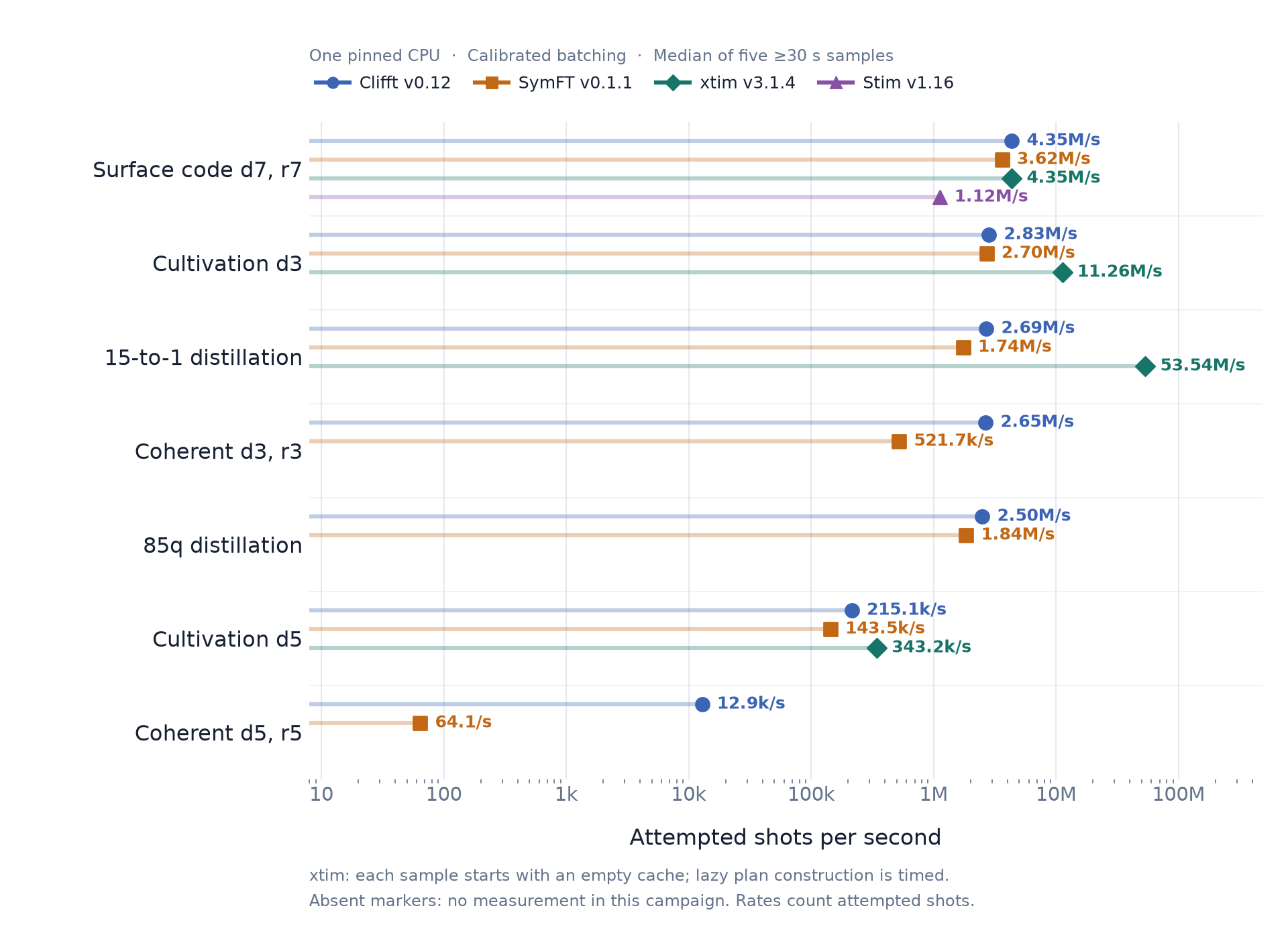
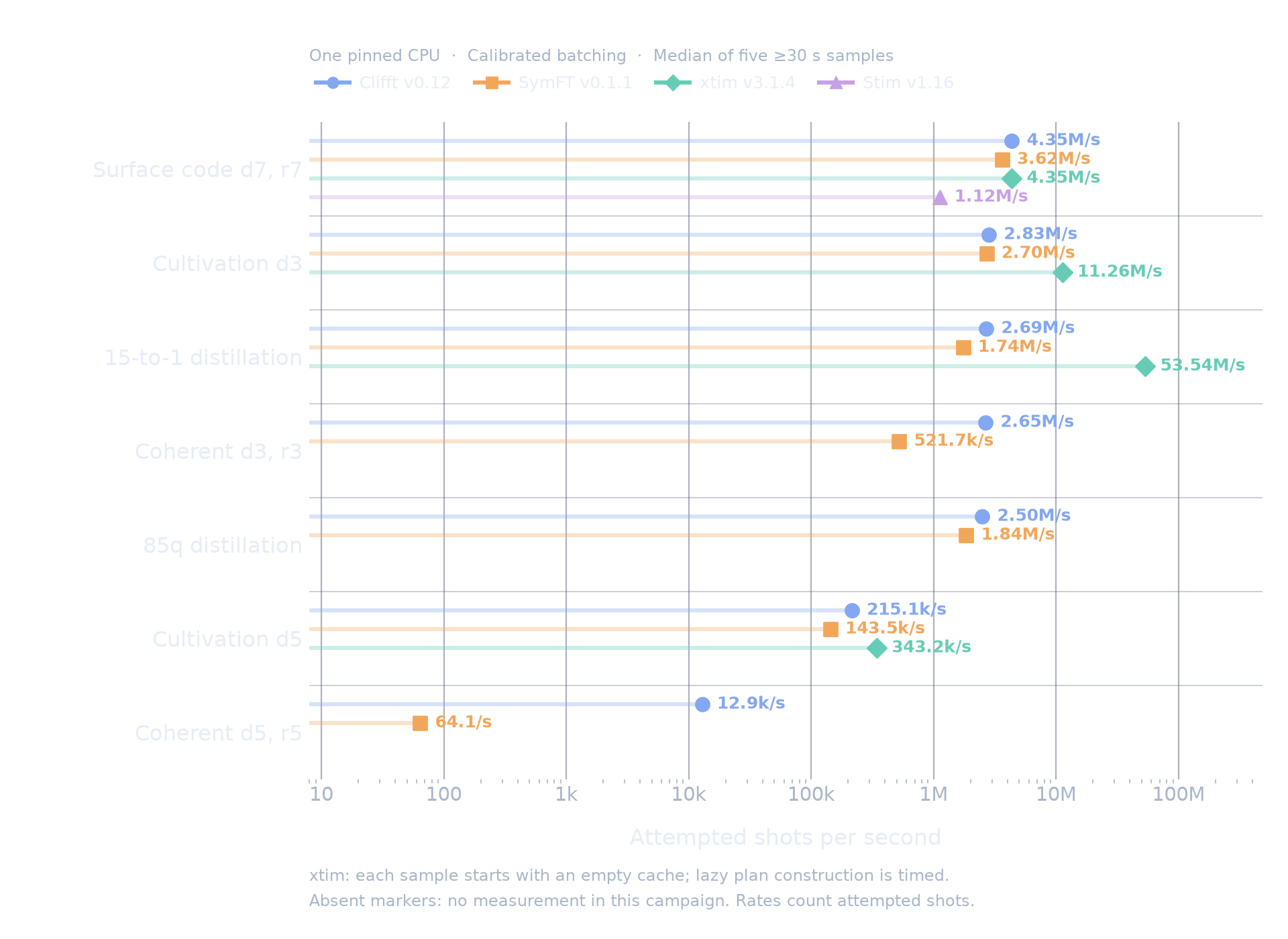
Clifft is faster than SymFT on all seven workloads, by 1.05x to 201x. xtim is faster than Clifft on cultivation d3/d5 and 15-to-1 distillation, by 1.60x to 19.9x, and essentially tied on the Clifford surface-code workload. Stim supplies a separate Clifford comparison below. Missing markers mean no measurement in this campaign; xtim has four measured workloads and Stim has one.
These are attempted-shot rates, so post-selected shots that are later discarded still count as simulation work. The run used one placement of an AWS m7a.xlarge with an AMD EPYC 9R14, Ubuntu 24.04, and one pinned logical CPU. Each reported configuration has five timed samples of at least 30 seconds. Compilation is measured separately and excluded from sampling throughput, except for lazy plan construction during sampling. In particular, each xtim sample starts with an empty plan cache and includes lazy planning; its rate is a fixed-duration average. All tools return aggregate counts. Stim and xtim materialize packed records that the adapter reduces to those counts, with both steps included in their timing.
The Clifft measurements use the published 0.12.0rc1 wheel, with 0.11.0rc1 as the previous-release baseline. Plot labels show the final release versions; only documentation has changed since the measured candidate. SymFT is pinned to 0.1.1 at upstream commit c89b985, and xtim to 3.1.4 at 2945407 with its portable build configuration. The harness calibrates numeric batch sizes independently; it does not use Clifft's new batch_size="tune" API.
See the immutable comparison table and the benchmark contract for the exact software identities, timing boundaries, and result semantics.
Clifford postselection with Stim
The surface-code d7/r7 circuit provides a separate Clifford comparison with Stim. Clifft reaches 4.35 million attempted shots/s, compared with 1.12 million for Stim, a 3.90x throughput ratio. Both tools sample the same circuit, reject shots with any detector event, and count observable errors among survivors.
This comparison uses the official Stim 1.16.0 wheel with calibrated chunking. It measures sampling, all-detector postselection, and aggregate counts on this workload, with compilation excluded. Clifft's ability to reject shots early is part of the measured execution strategy.
Changes in v0.12
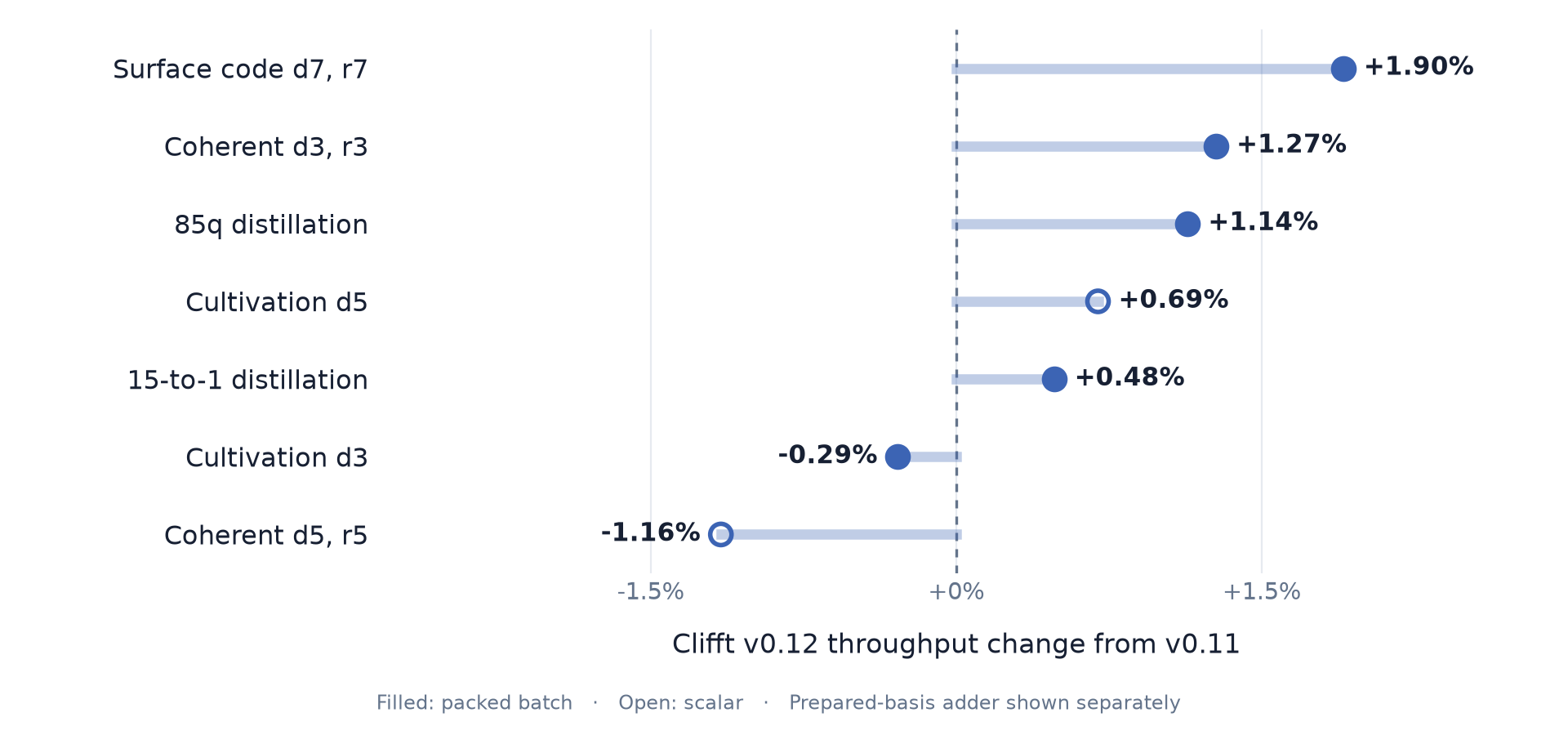
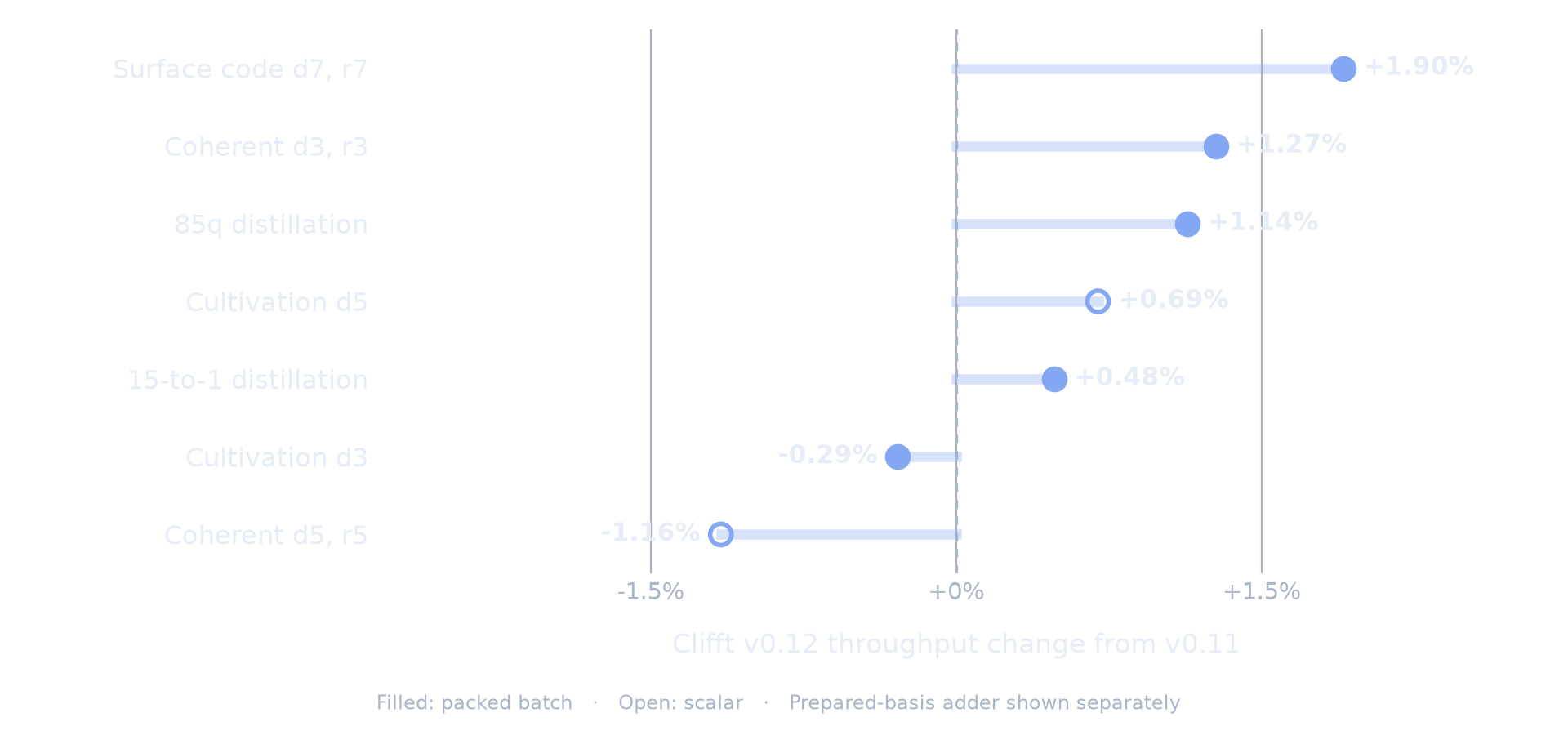
The seven QEC workloads changed by -1.16% to +1.90% on this host. These small differences do not establish a release-wide speedup. Both versions use their own default compiler passes followed by the opt-in scheduler and independently calibrated batching.
Performance over time
Clifft's compiler-like structure provides several independent places to make simulation faster: circuit optimization, symbolic planning, executable preparation, and active-state kernels. That structure does not mean every speedup comes from the compiler, but it lets later releases improve one stage without moving circuit analysis back into the per-shot execution loop.
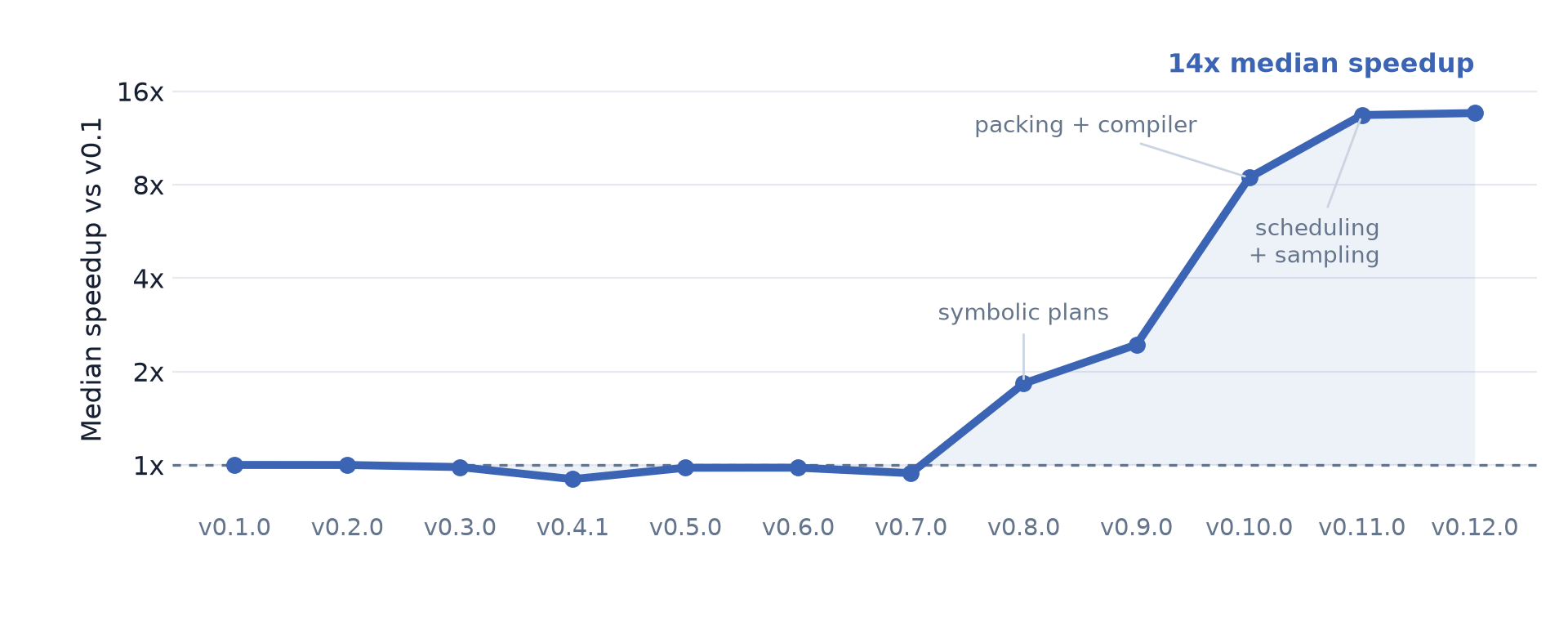
The first broad step arrived in v0.8, when symbolic plans replaced the original localized-Pauli virtual machine. Version 0.10 combined another compiler improvement with packed sampling. Version 0.11 builds on that work with operation scheduling and deferred noise sampling. Version 0.12 preserves that QEC throughput while adding state-aware compiler simplification.
The history plot reaches a 13.6x median speedup over v0.1. Every point uses the same six-workload reporting core. Earlier release posts used eight workloads; the current core omits the two single-round coherent circuits, so its historical medians differ from those earlier summaries. The new 15-to-1 workload appears in current comparisons without changing the history's six-workload core.
The largest v0.10 gain, 837x on coherent d=5, r=5, primarily reflects a compiler rewrite that reduced the circuit's peak active width from 24 to 13. This is why the release history is best read as the result of the whole compile-and-execute system, not as a benchmark of one kernel.
The v0.1 through v0.9 points come from a common history execution. For each workload, the v0.10 through v0.12 points chain the paired ratios from their respective release runs onto that history. The plot then takes the median across workloads at each version. This avoids treating an absolute difference between two host boots as a product change. The exact execution chain is recorded in reporting sources.
Dense Quantum Volume circuits
Near-Clifford structure is Clifft's main advantage. A dense Quantum Volume circuit instead drives the active width to the full qubit count, making Clifft carry a conventional \(2^n\) state vector. This deliberately tests Clifft where its specialized representation offers the least help.
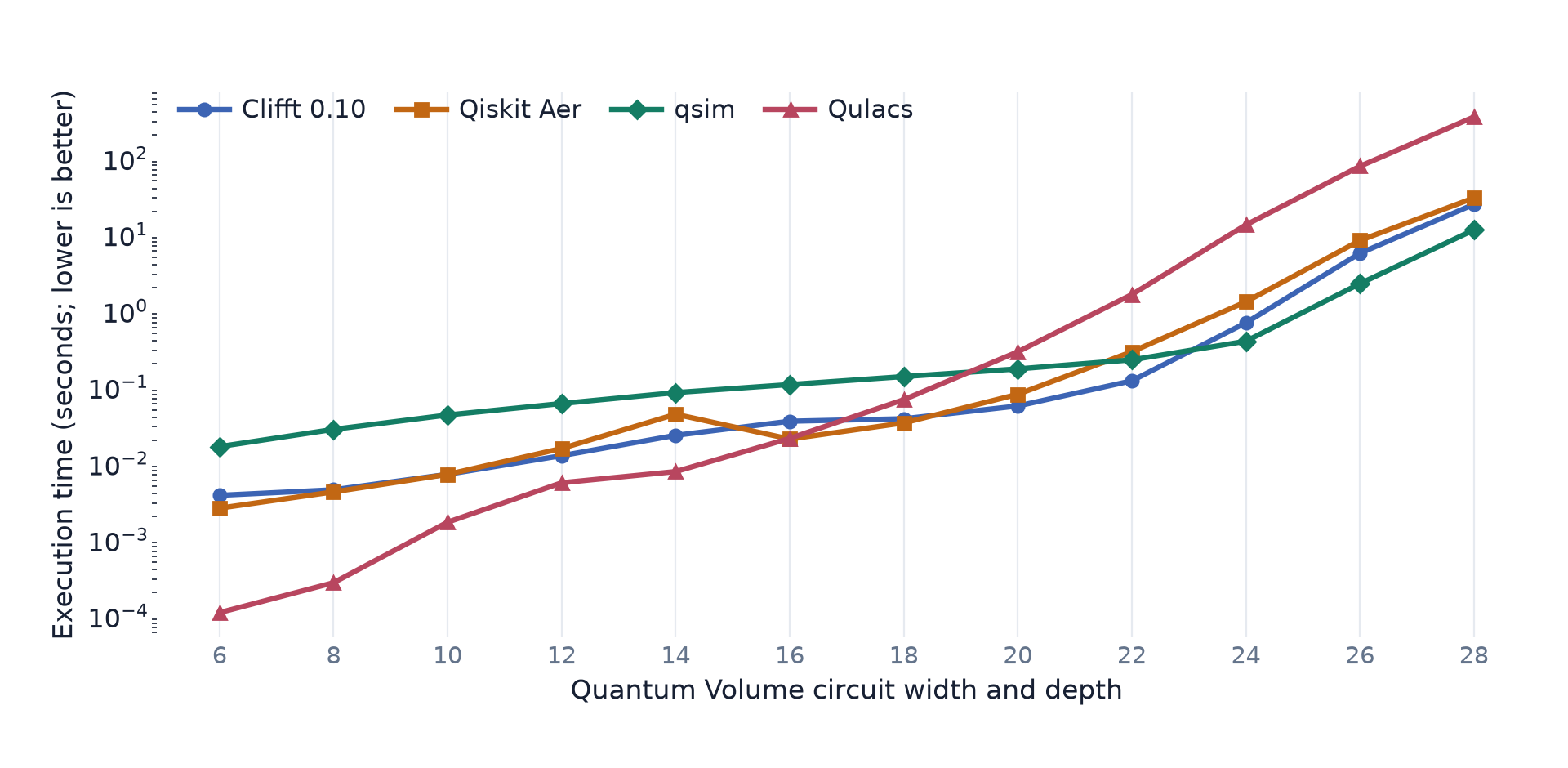
These are the existing Clifft 0.10.0rc1 measurements, using 16 physical CPU cores. Clifft records the shortest median execution time at QV20 and QV22. At QV28 it completes in 24.7 seconds, compared with 29.9 seconds for Qiskit Aer and 344.9 seconds for Qulacs; qsim leads at 11.4 seconds. Smaller widths favor tools with lower fixed overhead, and qsim leads from QV24 onward. The result is not that Clifft wins every dense workload, but that it remains in the leading group even outside its intended near-Clifford regime.
This experiment reproduces the original Clifft paper's timing boundaries. Clifft is charged for compilation plus one sample, while Qiskit transpilation and Qulacs/qsim circuit preparation occur before their timers. It is therefore not an equal end-to-end latency comparison. The experiment uses three circuit seeds per width on an AWS c8i.8xlarge; see the experiment description and complete result table.
Future benchmark scope
The near-Clifford comparison is CPU-only. GPU benchmarking remains ongoing work, including comparisons with Tsim under a separate hardware and measurement contract.